Santa Barbara is Hiring!
Santa Barbara businesses face a persistent challenge: hiring new employees. It's a fair question to ask, “Who wouldn't want to live and work here?” We agree. But the same qualities that make Santa Barbara so appealing, its climate, coastline, and quality of life, also drive up housing prices and rents. This report looks at why Santa Barbara struggles to attract workers even compared to places with comparable housing costs.
To understand who might choose to work in Santa Barbara, we first need to consider their alternatives. The two nearest large job markets are the San Francisco Bay Area and Los Angeles. Anyone weighing a job in either of those regions might also consider an opportunity in Santa Barbara. For that reason, our analysis uses these two cities as points of comparison. Imagine you are a nurse. You might consider living in the Bay Area, Los Angeles, or Santa Barbara, but you know that your wage goes a lot further in Los Angeles. There are more options of places to live and apartments to rent. Where would you go?

We start with the median rent for a two-bedroom apartment as our benchmark for housing costs, comparing Santa Barbara's South County against the East Bay, the Peninsula (San Mateo County), South Bay/Silicon Valley, San Francisco proper, and four areas of Los Angeles, downtown/central, the San Fernando Valley, South Bay/Long Beach, and the Westside. The rents in Table 1 come from the American Community Survey (ACS) five-year estimates for 2020 to 2024. Because of the survey's time lag, the rents shown here are lower than current market rents everywhere, since rents have continued rising since the data was collected.
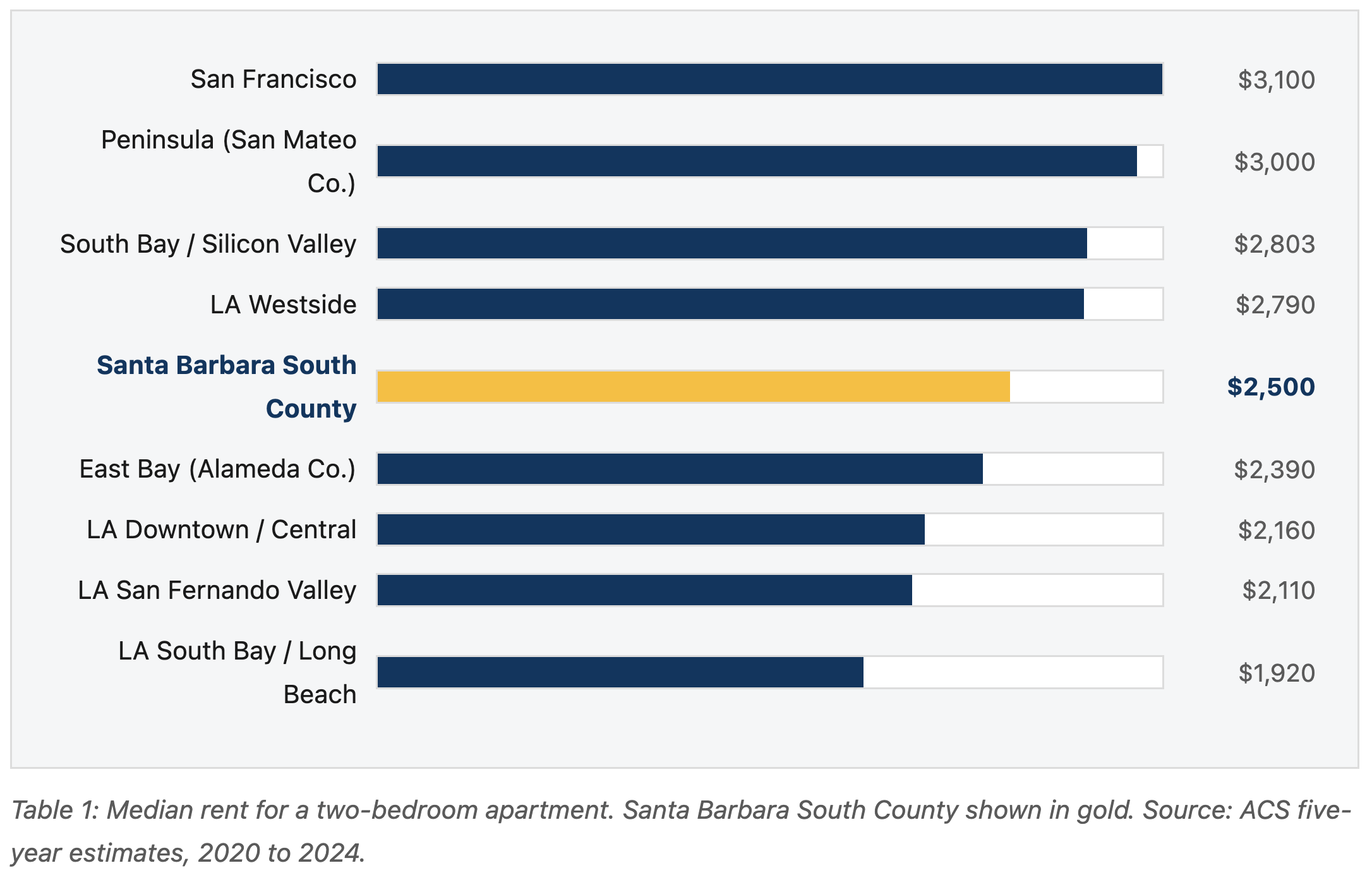
The main takeaway is that Santa Barbara's median rent is lower than, or close to, many of the other areas'. San Francisco, the Peninsula, South Bay, LA Westside, and the East Bay all have rents that are higher than, or close to, Santa Barbara's. Rents alone, then, cannot explain the difficulty of hiring.
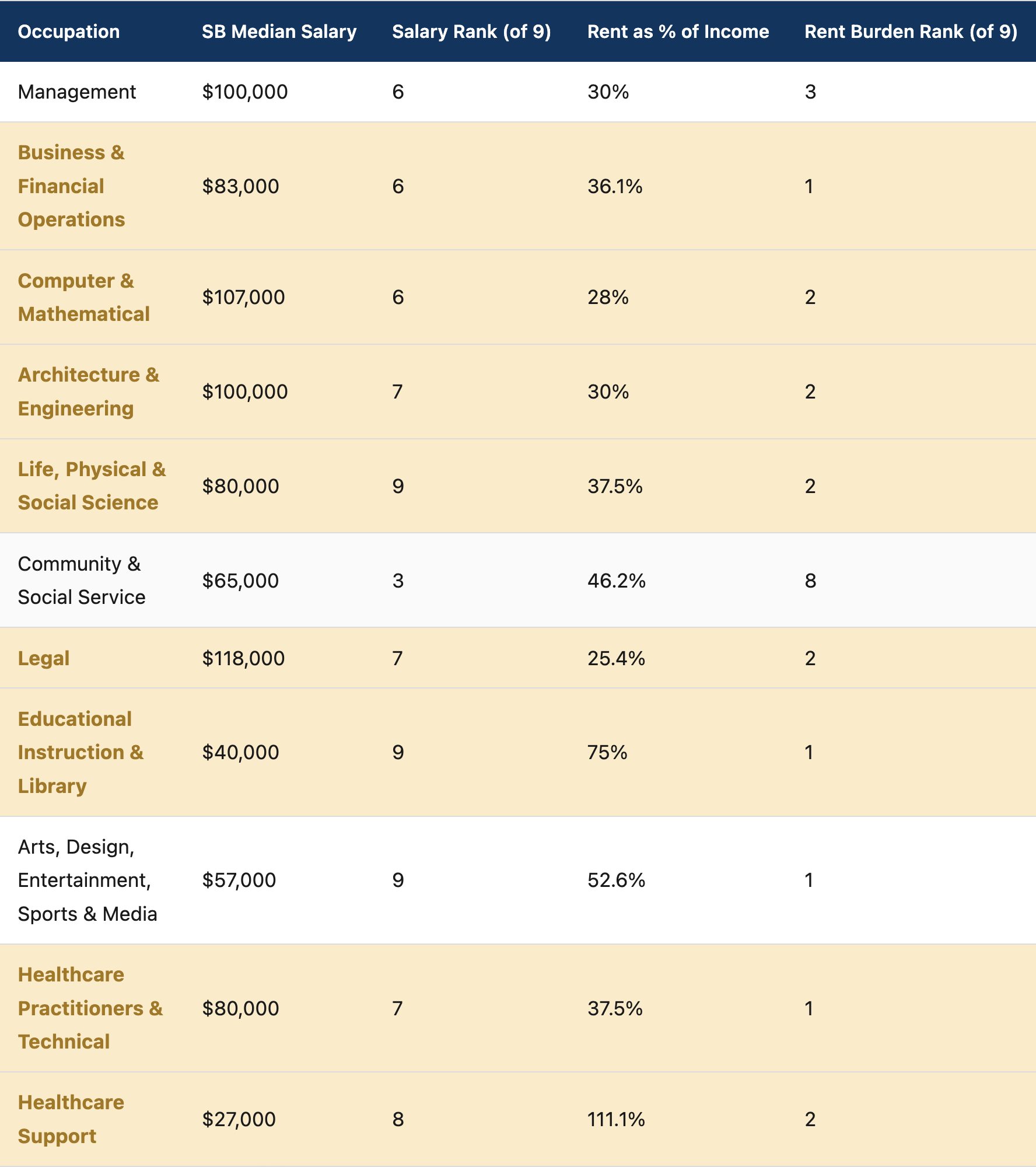
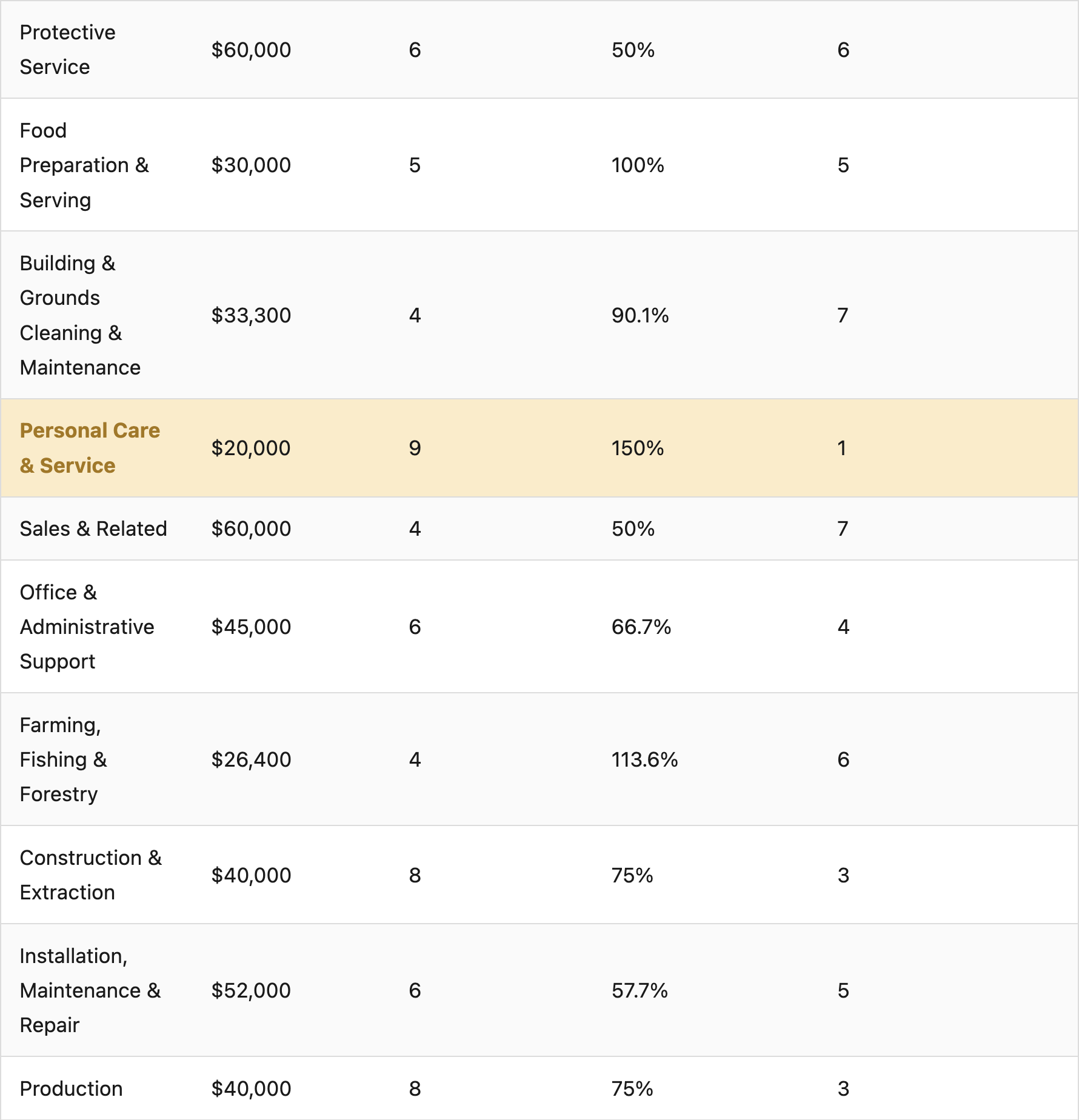
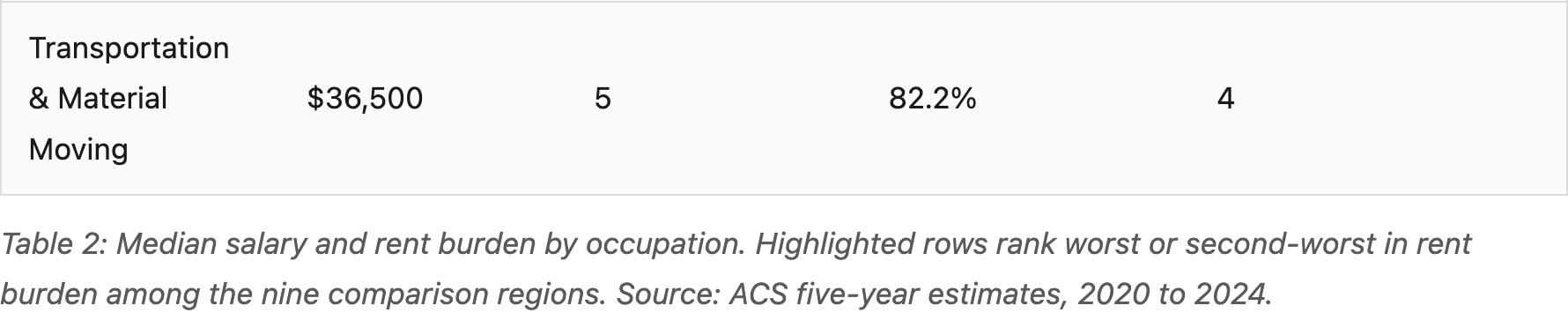
We take the analysis a step further by looking at median income by occupation in Santa Barbara and how it ranks against our nine comparison regions. Santa Barbara falls in the lower half of the rankings in 19 of 22 occupations, and ranks lowest or second-lowest in 7 of them. In many occupations, Santa Barbara's salary rank lands around fifth or sixth out of nine, roughly matching its position on rent.
A few categories stand out as particular concerns. Educational Instruction and Library ranks last, ninth, among our comparison regions, while Healthcare Practitioners and Healthcare Support rank near the bottom as well, at seventh and eighth.

When we hear about the struggle to hire nurses or teachers, this is a major contributing factor. People are paying almost the same price for rent, but are compensated less than the other regions.
Beyond wages alone, we can look at the rent burden placed on each occupation group. Rent burden is the percent of monthly income that would need to go to rent for a two-bedroom apartment. Of the 22 occupations, Santa Barbara ranks worst or second-worst in rent burden in 10 of them. Workers in the three fields mentioned above (education, healthcare practice, and health support) would need to spend 75%, 37.5%, and 111% of their income on rent, respectively.
Professional service occupations aren't spared either. Workers in business and finance, legal, and computer science also rank poorly on rent burden relative to our comparison regions. While these industries face less strain than healthcare workers and educators, professionals in Santa Barbara are still confronted with a real trade-off: accept a higher rent burden here, or move to one of the larger metropolitan areas where salaries stretch further.
High rent burdens relative to nearby metropolitan areas, while not the only factor shaping where people choose to live and work, are clearly a major one. Local businesses face a difficult choice: pay wages that keep pace with the cost of living, or risk asking workers to accept a lower standard of living after they pay rent in order to stay in Santa Barbara. Both dynamics shape hiring outcomes.