The Creative Economy
When people think of Santa Barbara's economy, they think agriculture, tourism, healthcare, or UCSB. But a new economic impact report shows the Creative Economy holds its own against some of the county's largest industries.
On March 3, 2026, the Santa Barbara County Board of Supervisors heard a presentation on the Economic Impact of the Creative Economy in Santa Barbara and Ventura Counties. The Board voted to receive and file the UCSB Economic Forecast Project's 2025 Creative Economy Report and Santa Barbara County Creative Economy Snapshot — a recommendation approved by the County Executive Officer. Dr. Peter Rupert presented the findings and answered questions from Supervisors and the public. The analysis was conducted by the EFP using IMPLAN economic modeling software.
The report defines the Creative Economy across twelve sectors: Architecture and Interior Design, Art Dealers, Communication Arts, Digital Media, Entertainment, Fashion, Furniture and Decorative Arts, Industrial Design Services, Publishing and Printing, Toys, Visual and Performing Arts Providers, and Fine and Performing Arts Schools.
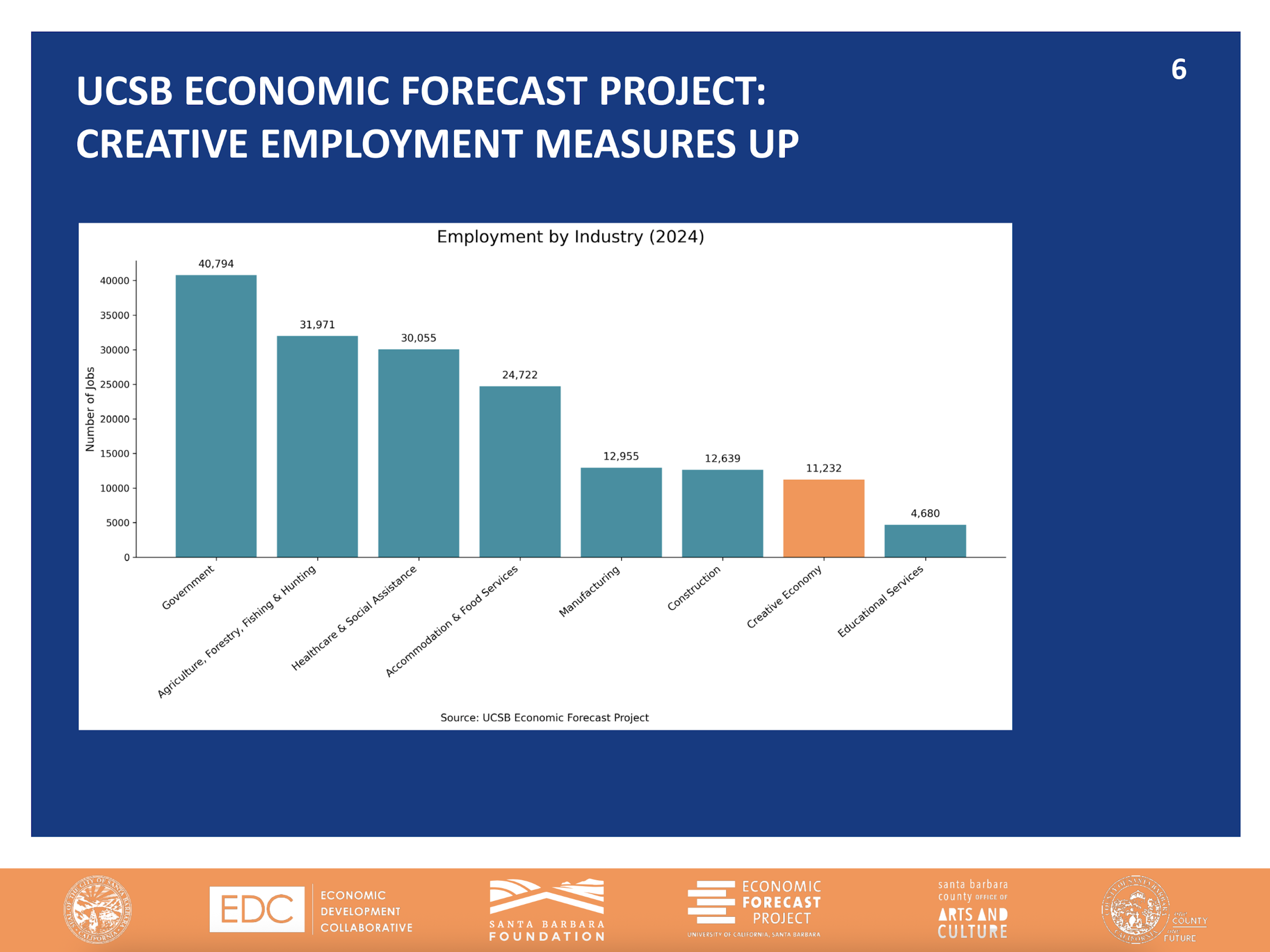
While the Creative Economy doesn't employ as many people as Government (40,794) or Agriculture, Forestry, Fishing, & Hunting (31,971), in Santa Barbara County, it supports 11,232 jobs — comparable to Manufacturing (12,955) and Construction (12,639). Of those jobs, 4,136 are direct, 3,887 are indirect, and 3,208 are induced. Total labor income associated with creative industry activity is estimated at $1.30 billion, with total value added of $2.19 billion and total output of $3.82 billion.
The creative economy also generates substantial fiscal benefits for governments at all levels. In Santa Barbara County, the creative sector produces a total fiscal impact of nearly $469.7 million, with direct activity alone accounting for $245.7 million in tax revenue. When indirect and induced effects are included, county government receives $23.7 million, the state receives $108.6 million, and federal coffers receive $290.8 million. These figures, expressed in 2026 dollars, underscore that the creative economy is not merely a cultural asset — it is a significant driver of public revenue that funds essential services across all levels of government.
Click here to access the UCSB EFP Creative Economy report.